Oracle's $553 Billion Backlog: Best Quarter in 15 Years, or the Most Expensive Bet in Cloud History?
We are launching primary research to determine whether Oracle's unprecedented cloud infrastructure backlog will convert into sustained high-margin revenue, or whether customer concentration, debt load, and execution risk make this the most precarious capital cycle in enterprise technology.
We are launching primary research to determine whether Oracle's unprecedented cloud infrastructure backlog will convert into sustained high-margin revenue, or whether customer concentration, debt load, and execution risk make this the most precarious capital cycle in enterprise technology.
Larry Ellison co-founded Oracle in 1977 after working on a CIA database project codenamed "Oracle" while at Ampex. For nearly five decades, the company's identity was inseparable from the relational database — the plumbing beneath the world's largest enterprises, embedded so deeply in mission-critical systems that switching costs alone sustained growth for decades. That identity is now being overwritten, at a speed and financial cost that has no precedent in the history of enterprise software.
Oracle just delivered what its own CFO called the company's best quarter in fifteen years. Q3 fiscal 2026 was the first quarter in over fifteen years where organic total revenue and non-GAAP earnings per share both grew at 20% or more simultaneously. Total quarterly revenues rose 22% to $17.2 billion, beating consensus by $280 million. Adjusted EPS came in at $1.79 against $1.70 expected. Cloud infrastructure revenue surged 84% year over year to $4.9 billion, accelerating from 68% growth in the prior quarter. Management raised fiscal 2027 revenue guidance to $90 billion — $3.6 billion above the street's prior expectation. Shares rose as much as 10% in extended trading.
The stock still sits more than 50% below its September highs. That gap is where the entire investment debate lives.
Oracle expects capital expenditures of $50 billion in fiscal 2026 — a figure that has pushed total debt above $100 billion and driven free cash flow to negative $24.7 billion over the trailing twelve months. Three quarters ago, free cash flow was essentially zero. The company raised $30 billion through bonds and preferred stock last month alone. Oracle is spending 75 cents on infrastructure for every dollar of revenue it generates. That is not how legacy software companies behave. It is the financial profile of a hyperscaler, adopted by a company that does not have the cash generation engine of an Amazon or a Microsoft to sustain it.
Bears see a company whose growth is funded entirely by debt and whose $553 billion RPO is dangerously concentrated around a single customer — OpenAI — with significant liquidity needs of its own. The Stargate Abilene collapse, reported by Bloomberg just days before earnings, crystallised the counterparty risk in a way that no amount of backlog commentary can fully offset. Bulls counter that the quarter demonstrates the backlog is converting: OCI growth accelerated from 68% to 84% in a single quarter, Oracle delivered more than 400 megawatts of capacity in Q3 with 90% on or ahead of schedule, and the new RPO structure means most large AI contracts require no incremental capital raise from Oracle. CFO Doug Kehring said the company would provide more detail on fiscal 2027 capex next quarter. That June disclosure is the next definitive moment for the stock. Between now and then, the rate at which $553 billion of contracted obligations converts into recognised revenue is the single most important variable in the trade.
Key Insights
Oracle's cloud infrastructure business is accelerating, not plateauing. OCI revenue grew 84% year over year to $4.9 billion, up from 68% growth in Q2. Cloud revenue now accounts for roughly 52% of Oracle's total sales, up from approximately 43% just a year ago. The trajectory the bulls needed to see landed above even the most optimistic forecasts heading into the print.
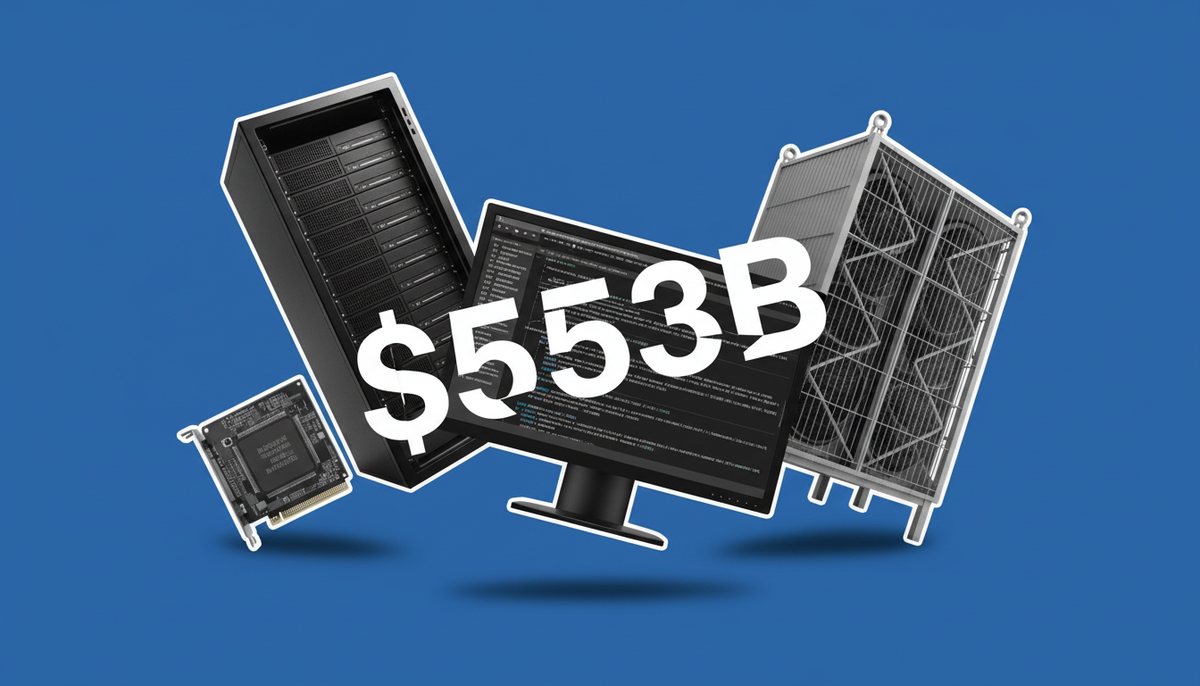
The RPO number is staggering and structurally different from prior quarters. Remaining Performance Obligations ended Q3 at $553 billion, up 325% from last year and up $29 billion sequentially. Critically, management disclosed for the first time that the new large-scale AI contracts are structured so that Oracle does not need to raise incremental capital to fund them — customers either prepay for GPUs or supply their own hardware. This is the first quarter where the RPO commentary directly addressed the funding question that has haunted the stock.
Free cash flow deterioration is severe and accelerating. Three quarters ago, Oracle's free cash flow was essentially zero. This quarter it clocked in at negative $24.7 billion over the trailing twelve months. Capital expenditures jumped as much as 269% in Q1 to $8.5 billion and are guided to $50 billion for the full fiscal year. S&P Global Visible Alpha's head of research noted that Oracle's debt-to-equity ratio stands between 3x and 4x, and that the balance sheet looks materially worse than its hyperscaler peers.
The Stargate Abilene episode exposed real counterparty risk. Oracle and OpenAI scrapped plans to expand the flagship Abilene data centre from 1.2 gigawatts to approximately 2.0 gigawatts after negotiations stalled over financing challenges and OpenAI's shifting demand forecasts. A multi-day outage earlier this year caused by winter weather disrupting liquid cooling reportedly damaged relations between OpenAI and site operator Crusoe. Bloomberg's Ed Ludlow clarified that the broader 4.5-gigawatt Oracle-OpenAI agreement remains intact. The distinction matters — but so does the signal.
Legacy software is stagnating and the mix shift is structurally compressing margins. Software revenues were up just 3% in USD and down 1% in constant currency to $6.1 billion. Non-GAAP operating income grew 19%, a slower pace than the 22% revenue growth. Gross margin compressed to approximately 67.8%, reflecting the lower-margin profile of cloud infrastructure relative to legacy software licence revenue. The investment case depends on OCI scaling into operating leverage before the legacy drag becomes material.
The FY27 guidance raise resets the earnings trajectory at a level that requires sustained execution. Oracle is guiding fiscal 2027 revenue to $90 billion, implying roughly 34% growth over FY26's $67 billion target. To get there, Oracle must sustain cloud growth above 40% while ramping OCI capacity on schedule across multiple geographies simultaneously. The gap between the guidance and the street's prior $86.4 billion expectation is where the bull case lives — and where the execution risk concentrates.
Participation Opportunity
Woozle Research is inviting professional investors to sponsor or co-sponsor this primary research. Participation is collaborative. All funds receive full access to research outputs including interview summaries, transcripts, and the final synthesis report.
Launch: March 14, 2026 Delivery: March 28, 2026 Participation cap: Limited to 5 funds
Research scope: 35+ CIO and VP-level cloud infrastructure procurement interviews at Fortune 500 enterprises, 20+ former Oracle and OCI employee interviews, 15+ competitor and channel partner interviews including hyperscaler sales teams and GPU supply chain contacts
Deliverables: Raw data, transcripts, synthesis report, analyst access
This research will proceed with a minimum of one fund and is limited to a maximum of five. Email to confirm your interest.
The Catalyst
The scale of Oracle's pivot is hard to overstate. In late 2024, the company repositioned itself from a database incumbent into a premier provider of AI-optimised cloud infrastructure, leveraging its RDMA networking architecture to offer faster and cheaper AI training environments than its larger rivals. The argument was that Oracle's purpose-built networking layer delivered measurable performance advantages for the large-scale GPU clusters that AI training requires — an advantage the hyperscalers, with their more generalised infrastructure, could not immediately replicate.
The market initially rewarded the narrative. Oracle's shares reached all-time highs in September 2025 following the announcement of the $300 billion Stargate partnership with OpenAI. The subsequent sell-off of more than 50% from those highs reflects the market's reassessment of whether the capex cycle is a bridge to a dominant cloud position or a debt-financed infrastructure build whose economics will never recover to the margin profile of the software business it is displacing.
The Q3 results offer the strongest evidence yet that the revenue line is responding. Cloud infrastructure growth accelerated for the second consecutive quarter. The company highlighted new enterprise wins with Air France-KLM, Lockheed Martin, SoftBank, and Microsoft's Activision Blizzard subsidiary. Oracle's multi-cloud database strategy — which places Oracle Database directly inside AWS, Azure, and Google Cloud data centres — is creating a secondary demand engine with its own growth trajectory. Larry Ellison noted that multi-cloud database revenue grew at 1,529% in Q1. Even discounting the small-base effect, the directionality is unambiguous.
The more troubling narrative sits in the capital structure and the concentration of the backlog. A $553 billion RPO is only as durable as the customers behind it. The Abilene episode illustrated what happens when Oracle's most important customer — OpenAI — recalibrates its infrastructure needs in response to shifting chip cycles, power timelines, and financing priorities. OpenAI chose not to expand capacity at a site where power delays would have meant deploying hardware that was a generation behind by the time it went live. That is a commercially rational decision for OpenAI. It is an execution risk for Oracle that the RPO headline number does not capture.
The competitive window that gave Oracle its opening is also compressing. Oracle's OCI advantage was built during a period when AWS, Azure, and Google Cloud were slower to deploy dedicated AI training clusters at scale. The eight largest hyperscalers are now expected to spend a collective $710 billion in 2026 alone, much of it on precisely the infrastructure Oracle built its differentiation on. Microsoft's commercial RPO stands at $625 billion, spread across Azure, Microsoft 365, and dozens of enterprise products — a diversification that makes it structurally more resilient to any single contract renegotiation than Oracle currently is. The question is not whether Oracle's networking architecture is genuinely differentiated today. It is whether that differentiation persists for long enough to justify the capital cycle now underway.
The June earnings will be the next definitive moment. CFO Doug Kehring's promised FY27 capex disclosure will tell the market whether Oracle believes the infrastructure buildout is peaking or accelerating. Between now and then, the variable that matters is not the RPO total — it will continue to look impressive — but the quarterly pace at which that backlog converts into recognised revenue. If OCI growth sustains above 80% and Q4 meets guidance, the stock re-rates. If conversion slows while capex remains elevated, the free cash flow pressure intensifies and the case for a value trap strengthens materially.
Key Intelligence Questions
The research will focus on the commercial and operational dynamics that determine whether Oracle's AI infrastructure buildout converts contracted demand into sustainable revenue growth, or whether execution risk, customer concentration, and competitive intensity erode the backlog before it reaches the income statement.
OCI Adoption: Are Enterprise Workloads Sticking, or Is Oracle Winning on Price Alone?
Oracle Cloud Infrastructure has positioned itself as a cost-competitive alternative to the major hyperscalers, particularly for AI training workloads where its RDMA networking architecture delivers measurable performance advantages. Adoption by OpenAI, despite that company's access to multiple cloud providers, is frequently cited as evidence of real technical differentiation. But the investment case depends on whether OCI can attract and retain enterprise workloads beyond the hyperscale AI contracts that dominate the RPO. Oracle highlighted wins with Air France-KLM, Lockheed Martin, SoftBank, and Activision Blizzard. The question is whether these represent the beginning of a broader enterprise migration or cherry-picked case studies that mask a narrow customer base.
If Oracle is winning primarily on price with thin switching costs, the revenue quality is lower than the headline growth rate suggests and churn risk accumulates as hyperscalers close the pricing gap. If enterprises are committing to OCI for multi-year workloads because of genuine technical advantages in networking, security, or database integration, the flywheel has compounding legs. CIOs and VP-level cloud infrastructure procurement leads at Fortune 500 enterprises currently evaluating OCI against AWS and Azure would directly illuminate whether these are full-stack platform commitments or narrow, price-driven infrastructure deals with limited stickiness.
Backlog Conversion: Is $553 Billion of RPO Real Revenue or Contractual Optionality?
Oracle's RPO of $553 billion is so large relative to annual revenue that even modest changes in conversion timing swing the earnings trajectory by billions. The Stargate Abilene episode illustrated this risk concretely: OpenAI chose not to expand capacity at a site where power delays would have meant deploying hardware a generation behind by the time it went live. The result was a contracted obligation that did not convert on its expected timeline, while the capex committed to support it had already been incurred.
The structure of the new RPO contracts — where customers prepay for GPUs or supply their own hardware — shifts some capital risk away from Oracle. But it also raises questions about what Oracle is actually providing in these arrangements. A cloud platform with pricing power looks very different from a colocation facility with limited margin upside. Former Oracle enterprise sales executives and cloud deal structurers could clarify how much pricing flexibility Oracle retains in these contracts, what typical ramp timelines look like, and how frequently customers renegotiate terms mid-contract. GPU supply chain contacts at Nvidia could illuminate whether Oracle's customer-supplied GPU model signals genuine committed demand or creative contract structuring designed to reduce Oracle's capital burden without guaranteeing revenue.
Competitive Dynamics: Can OCI Hold Its Position as Hyperscalers Scale AI Infrastructure?
Oracle's networking advantage was built during a window when the major cloud providers were slower to deploy dedicated AI training clusters. That window is closing rapidly. The eight largest hyperscalers are expected to spend a collective $710 billion in 2026 alone. Microsoft's commercial RPO stands at $625 billion spread across a diversified product portfolio that makes any single contract renegotiation immaterial. AWS has deployed dedicated AI training infrastructure at scale. Google Cloud's TPU architecture offers an alternative performance profile for specific workloads.
The competitive question is whether Oracle's RDMA networking, its multi-cloud database strategy, and its sovereign cloud deployments create durable differentiation — or whether the hyperscalers replicate Oracle's advantages at greater scale and lower cost within 12 to 18 months. Cloud infrastructure sales leads at AWS, Azure, and Google Cloud could reveal whether they are seeing OCI customers evaluate multi-cloud alternatives, whether Oracle's pricing advantage is narrowing in competitive evaluations, and which workload types Oracle is winning versus losing when it goes head-to-head with a fully resourced hyperscaler sales team.
Customer Concentration: How Dependent Is Oracle on OpenAI and a Handful of AI Anchor Tenants?
The RPO disclosures do not break out individual customer concentration, but the Stargate partnership, the disclosed multi-billion-dollar relationships with Meta and Nvidia, and the prominence of AI-related commentary on every recent earnings call suggest that a small number of anchor tenants drive a disproportionate share of the backlog. The Abilene episode demonstrated that even Oracle's most important customer relationship is subject to renegotiation when chip cycles, power timelines, and counterparty priorities shift. A company whose growth thesis depends on three to five anchor customers absorbing massive new capacity is in a fundamentally different risk position from one with diversified enterprise revenue.
Former IT leads at recently announced Oracle customer wins — including Memorial Hermann Health System, University of New South Wales, and Investec Bank — could validate whether Oracle's enterprise pipeline is diversifying meaningfully beyond the AI hyperscale contracts. The distinction between a cloud platform with broad enterprise adoption and an infrastructure provider with a handful of anchor tenants is the difference between a re-rating and a value trap, and it is not visible in the headline RPO figure.
Margin Trajectory: Does OCI Scale Into Profitability, or Is Infrastructure Growth Structurally Lower Margin?
Oracle's gross margin compressed to approximately 67.8% this quarter, reflecting the lower-margin profile of cloud infrastructure relative to legacy software licences. Non-GAAP operating income grew 19%, slower than the 22% revenue growth. The mix shift toward OCI — which involves renting GPU capacity at margins structurally thinner than selling database licences — creates a compounding tension: revenue growth accelerates while margin expansion lags. The bull case assumes that as OCI data centres reach higher utilisation rates, operating leverage emerges and the margin gap narrows. The bear case argues that GPU rental economics never recover the margin profile of the legacy software business Oracle is displacing.
Current and former Oracle finance and operations executives could clarify the unit economics of a fully ramped OCI data centre versus one in early deployment, what utilisation rates are required for margin accretion, and whether the customer-supplied GPU model changes the margin structure in a way that public disclosures do not capture. This is the variable that determines whether the FY27 guidance of $90 billion in revenue translates into meaningful earnings improvement or simply a larger, lower-margin business than the one Oracle built its valuation on.
How to Participate
Woozle Research is inviting professional investors to sponsor or co-sponsor this primary research. Participation is collaborative. All funds receive full access to research outputs including interview summaries, transcripts, and the final synthesis report.
Launch: March 14, 2026 Delivery: March 28, 2026 Participation cap: Limited to 5 funds
Research scope: 35+ CIO and VP-level cloud infrastructure procurement interviews at Fortune 500 enterprises, 20+ former Oracle and OCI employee interviews, 15+ competitor and channel partner interviews including hyperscaler sales teams and GPU supply chain contacts
Deliverables: Raw data, transcripts, synthesis report, analyst access
This research will proceed with a minimum of one fund and is limited to a maximum of five. Email to confirm your interest.