Nintendo’s Memory Crisis: Can Switch 2 Protect Profits Without Killing Demand?
We are launching primary research to evaluate if Nintendo's price increase on Switch 2's will impact medium term earnings outlook.
✦
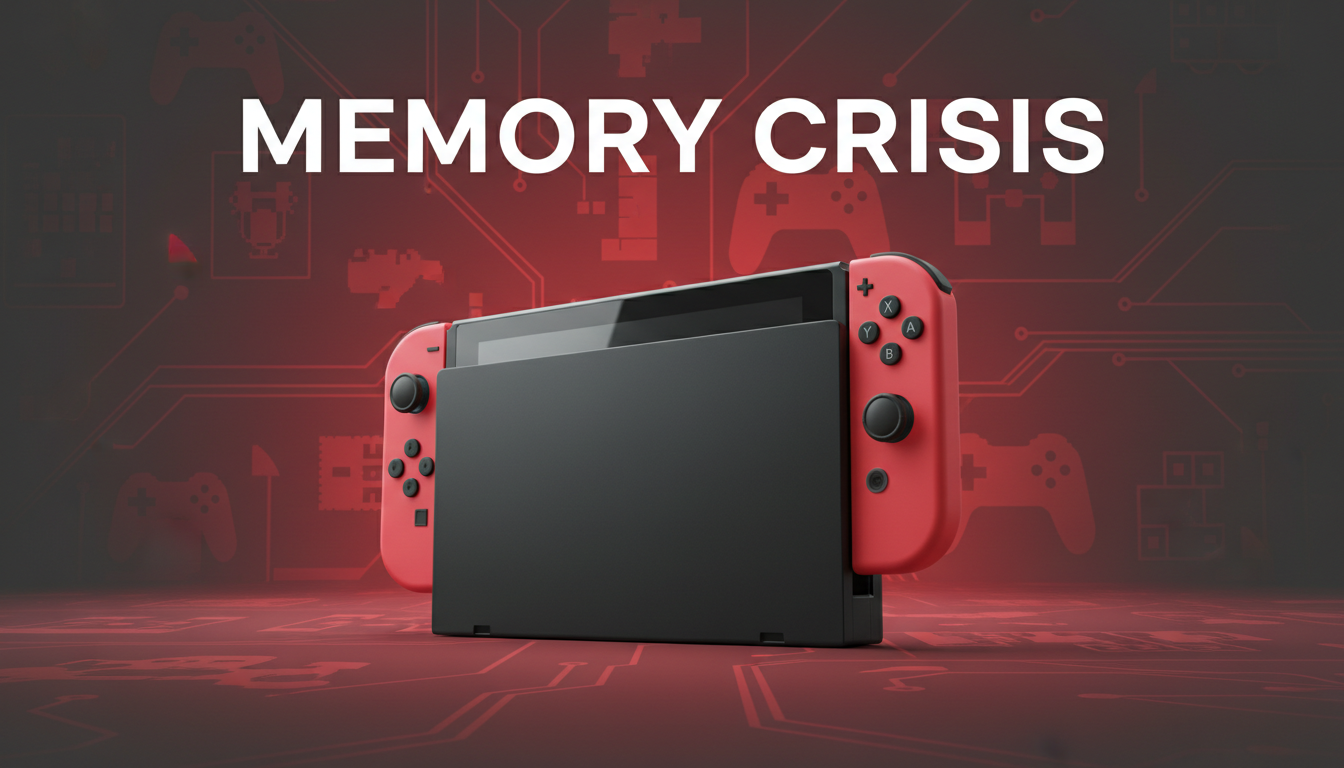
Nintendo’s Switch 2 is the first AAA consumer device to run head‑on into the AI‑driven memory crisis, forcing management to choose between margin compression and a mid‑cycle MSRP hike in 2026. We are launching primary research to answer the question the market cannot: does Nintendo protect scale or protect margins?
Nintendo’s new Switch 2 launched in June 2025 at roughly a 30–40% price premium to the original hardware and has already sold over 17 million units, outpacing its predecessor’s early trajectory. Now the console’s unit economics are being upended by a global DRAM and NAND shortage driven by AI data‑center demand, with the price of Switch 2 RAM up ~41% this quarter and internal storage costs also moving higher. The crux: management is “contemplating” a 2026 price increase on a live platform just as it enters the crucial year‑two adoption window, with investors split on whether Nintendo will accept lower hardware margins, raise prices and risk demand, or cut specs and damage the platform’s longevity.
Meanwhile, the same supply shock is forcing Sony to rethink the timing and spec envelope of its next‑gen PlayStation—effectively extending the Switch 2’s competitive runway at the very moment its bill of materials is blowing out. Memory makers Samsung, SK hynix, and Micron have redirected wafer capacity toward high‑bandwidth memory for AI accelerators, leaving traditional DRAM under‑supplied and pushing some spot prices up 50–75% in weeks. Nintendo’s management has already warned that memory prices are rising “faster than expected” and signaled that they will “flexibly consider various options” around pricing, cost, and profitability. The market has no conviction on which path they take—or what it means for software attach, third‑party support, and the broader console cycle.
We are launching primary research to find out.
Key Insights
- Hardware margins are under acute pressure. Switch 2 RAM modules are now ~41% more expensive and its 256GB internal storage is ~8% pricier to source, with SD Express card pricing also inflating for consumers. Nintendo’s shares have already shed around 4–5% on fears that surging memory costs will erode profitability or force a price hike that slows the installed base.
- AI has hijacked the memory supply curve. AI data centers are draining DRAM and HBM supply, with GPU clusters consuming unprecedented amounts of high‑bandwidth memory and pulling wafer capacity away from commodity DRAM used in consoles, PCs, and smartphones. DRAM makers are prioritising HBM and LPDDR for AI accelerators where margins are higher, creating a structural—not transitory—squeeze on consumer‑grade memory through at least 2026.
- Switch 2 demand is strong—for now. Nintendo has shipped roughly 17.4 million Switch 2 units since launch, beating its own early forecasts and more than doubling the original Switch’s pace over an equivalent window. The platform is tracking toward a 19 million unit target for its first fiscal year, supported by flagship titles like Mario Kart World and a robust first‑party slate.
- Platform pricing is now a live debate. Bloomberg and specialist press report that Nintendo is actively weighing a 2026 MSRP increase for Switch 2 to offset memory inflation, with some analysts suggesting a move toward the USD 499 range in key markets. Management commentary emphasises balancing adoption, profitability, and market conditions, but provides no clear framework for how far—or how fast—they are willing to move price.
- Competitive dynamics may mask execution risk. Sony is reportedly reconsidering the launch timing of its next console because of the same memory constraints, with some expectations sliding into 2028–2029. The risk is that investors mistake an unusually benign competitive window for proof that Nintendo can push through price or spec changes without demand consequences.
Participation Opportunity
Woozle Research is inviting professional investors to sponsor or co‑sponsor this primary research. All participants receive full access to interview notes, transcripts, and the final synthesis report.
- Launch: February 24, 2026
- Delivery: March 10, 2026
- Participation: Limited to 5 funds
- Catalyst: Memory‑driven cost shock, potential Switch 2 price hike, next‑gen console timing
- Research: 30+ Nintendo and third‑party retail/channel checks, 20+ supply‑chain and component vendor interviews
- Deliverables: raw data, transcripts, synthesis report, analyst access
Sponsor this research
This research will proceed with a minimum of one fund and is limited to a maximum of five.
Email to confirm your interestThe Catalyst
Nintendo’s hardware strategy has historically been built on accessible pricing, conservative silicon, and high‑margin software, rather than chasing bleeding‑edge specs. Switch 2 followed that playbook: a modest performance upgrade, hybrid form factor preserved, and a launch price that left room for later promotional flex. But the global memory shortage is disrupting that model in real time. DRAM and NAND costs are rising quarter‑on‑quarter, and the console’s BOM is inflating just as volumes ramp and promotional pressure would ordinarily begin.
The memory shock is exogenous—driven by hyperscale AI infrastructure build‑outs, not gaming demand. AI servers are absorbing both high‑bandwidth memory and conventional DRAM at unprecedented rates, with each GPU node pairing hundreds of gigabytes of HBM with multi‑terabyte DDR banks. Memory manufacturers are reallocating capacity to these higher‑margin products, leaving commodity segments structurally under‑supplied and pushing through price increases across the consumer electronics value chain.
Nintendo now faces a compressed decision window. Year two of a console lifecycle is typically when hardware pricing, bundle strategy, and component cost roadmaps converge to define the platform’s long‑term profitability. Instead, management must make pricing and volume decisions against an unstable cost base and uncertain supply outlook. Bloomberg’s reporting that Nintendo is considering an MSRP increase in 2026 has already rattled investors who worry about elasticity at a time when macro headwinds and accessory inflation (notably SD Express storage) are raising the all‑in cost of ownership for consumers.
At the same time, competitors are hamstrung by the same constraints. Sony’s next‑gen PlayStation roadmap is reportedly being pushed back, giving Switch 2 an unusually long window as the default “new” console for the mass market. The paradox is clear: Nintendo has more pricing power than usual because of limited competition, but less flexibility than usual because memory costs are compressing margins faster than software profits can offset. The market needs to understand how management will navigate that trade‑off—and how sensitive sell‑through is to even modest price moves.
Key Intelligence Questions
Our research will focus on the commercial and supply‑chain dynamics that determine whether Switch 2 remains a volume‑driven profit engine or a margin‑dilutive placeholder until the next console cycle. Each question targets a specific input to the investment model.
Hardware economics: where is the pain?
The bear case is straightforward: memory costs stay elevated through 2026, forcing Nintendo either to raise prices, accept structurally lower hardware margins, or reduce memory specs via mid‑cycle revisions. Each path carries risk—to demand, to the software attach rate, or to platform longevity.
Key Intelligence Question
- How are channel partners and internal stakeholders characterising current Switch 2 unit economics—are rising DRAM/NAND costs being absorbed, offset with mix, or passed through via pricing and bundles?
Price elasticity: how much headroom is left?
Investor debate centres on whether Nintendo can push Switch 2 toward a higher price point without breaking demand, particularly in price‑sensitive regions and during peak promotional periods. The installed base trajectory determines the future software and digital revenue pool; a poorly calibrated price hike could cap lifetime value.
Key Intelligence Question
- How do retailers and distributors expect consumers to respond to a potential USD/EUR 50–100 price increase—does elasticity differ by region, by bundle composition, or by timing relative to key releases? At what effective price (console plus essential storage) do attach rates for first‑ and third‑party software begin to fall off in practice?
Supply‑chain resilience: can Nintendo secure memory?
Nintendo is a price taker in the DRAM and NAND markets, competing with hyperscalers whose AI infrastructure budgets dwarf console volumes. TrendForce and others indicate that SK hynix and peers are allocating a growing share of wafer starts to HBM and server‑grade products, with consumer segments absorbing the residual. The question is whether Nintendo has negotiated the capacity and pricing protection required to sustain current production plans without repeated BOM shocks.
Key Intelligence Question
- What visibility do Nintendo’s memory suppliers have on 2026–2027 DRAM and NAND pricing and allocation for consumer devices? Are there credible pathways—long‑term contracts, alternative suppliers, process node shifts—to stabilise Switch 2 memory costs over the next 12–24 months?
Platform strategy: volume vs. ARPU
A central unknown is how Nintendo balances the trade‑off between installed base scale and average revenue per user. A higher hardware price may slow unit growth but could be offset by higher software pricing, digital monetisation, or a more aggressive first‑party release cadence. Conversely, preserving a lower entry price while absorbing cost inflation relies on outsized software profitability and attach rates.
Key Intelligence Question
- How do internal and channel stakeholders see the optimal balance between hardware volume and per‑user monetisation for Switch 2 over the next three years? Is there evidence that Nintendo is preparing complementary levers—software pricing, subscription offerings, DLC intensity—to offset hardware margin compression?
Competitive timing: does a longer runway change the playbook?
If Sony’s next‑gen console is delayed into the late 2020s, Switch 2 enjoys a longer‑than‑usual window as the “new” console for families and younger gamers. That may embolden Nintendo to accept higher pricing or experiment with higher‑margin SKUs. The risk is that management overestimates this window or underestimates latent demand elasticity, especially if macro conditions soften.
Key Intelligence Question
- How do retailers, publishers, and Nintendo insiders view the competitive landscape over the next 3–4 years in light of memory‑driven delays to rival hardware? Is Nintendo behaving as if it has a multi‑year runway—e.g., in inventory planning, marketing spend, and product pipeline—or as if the window could close faster than investors assume?
How to Participate
Woozle Research is inviting professional investors to sponsor or co‑sponsor this primary research. Participation is collaborative; all funds receive full access to interview summaries, transcripts, and our final synthesis.
- Launch: February 24, 2026
- Delivery: March 10, 2026
- Participation: Limited to 5 funds
- Catalyst: AI‑driven memory crisis, Switch 2 price decision, next‑gen console timing
- Research: 30+ retail and channel checks across key regions, 20+ supply‑chain and component interviews
- Deliverables: raw data, transcripts, synthesis report, analyst access
Sponsor this research
This research will proceed with a minimum of one fund and is limited to a maximum of five.
Email to confirm your interestThis document is for informational purposes only and does not constitute investment advice or a recommendation to buy or sell any security. Woozle Research conducts primary research on behalf of institutional investors. All research is conducted in compliance with applicable regulations.